
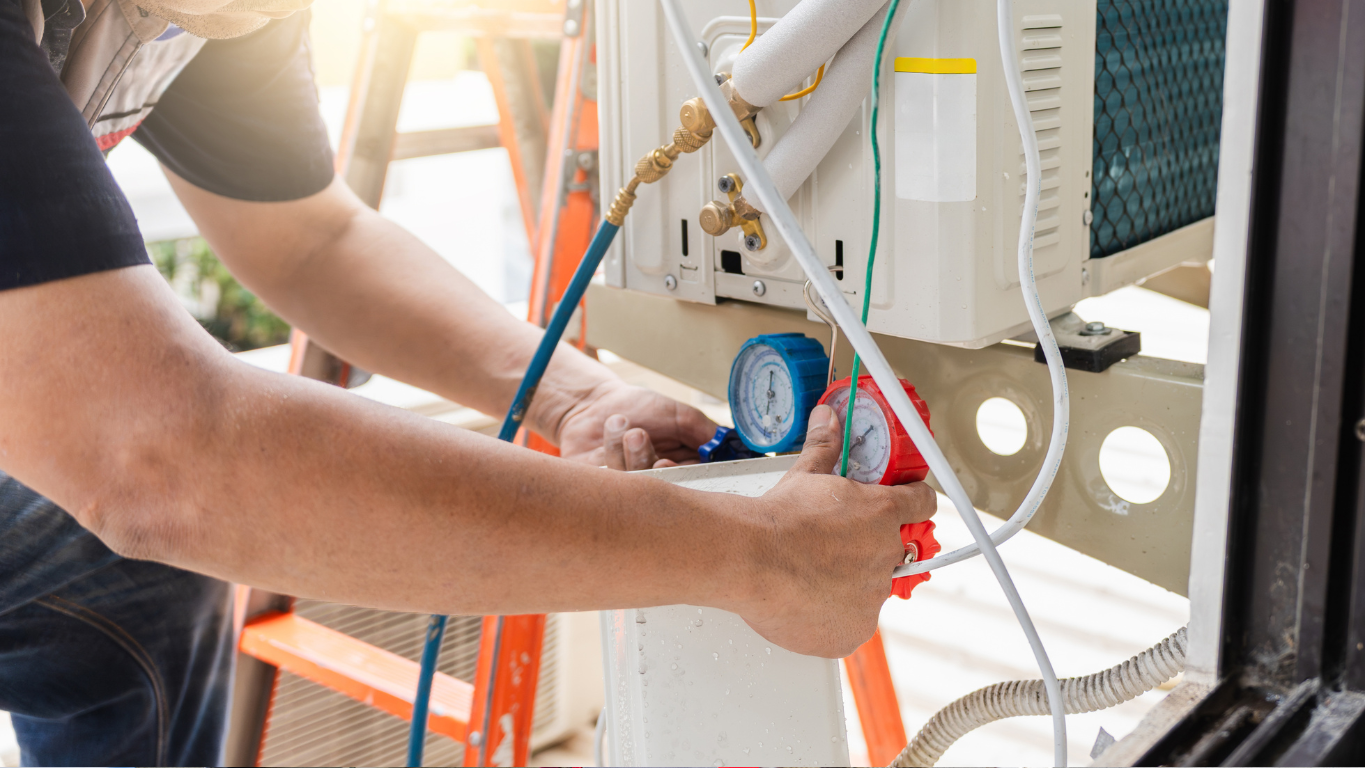
It’s a familiar story. Your A/C stops cooling on a hot afternoon. You call a technician. He hooks up some gauges, tells you you’re “a little low on Freon,” adds a few pounds, charges you $300, and leaves.
The A/C works great… for about three months. Then, the air gets warm again, and you do it all over again.
You might think this is normal maintenance, like putting gas in your car or changing the oil. It isn’t.
As the area’s trusted HVAC experts, Fast Air Conditioning Repair believes in fixing problems, not just patching them. This expert guide explains why your system is losing refrigerant, why “topping it off” is burning a hole in your wallet, and how to fix it for good.
The “Gas Tank” Analogy vs. The Reality
The biggest misconception homeowners have is that an A/C naturally “uses up” or “burns” refrigerant over time.
- The Myth: Like a car consumes gas, an A/C consumes refrigerant to create cold air.
- The Reality: Your A/C is a sealed system, more like your body’s circulatory system or your refrigerator. It circulates refrigerant in a continuous closed loop, changing it from liquid to gas to absorb and release heat. It does not burn it, consume it, or exhaust it.
- The Conclusion: If your system is low on refrigerant, there is only one possibility: You have a leak.
Why “Topping It Off” is a Bad Investment

Paying to refill a leaking system is like pumping air into a tire with a nail in it—without removing the nail. It works for a few miles, but you are destined to be flat again.
- The Cost: Refrigerant prices have skyrocketed (especially for older R-22 systems). You are literally venting hundreds of dollars into the atmosphere every year.
- The Damage: Refrigerant doesn’t just cool the air; it also carries the oil that lubricates your compressor. A system running low on refrigerant creates high temperatures and friction. By ignoring the leak, you are slowly killing the compressor (the heart of the system), leading to a premature and costly total replacement.
- The Efficiency Hit: An under-charged unit runs longer cycles to reach the set temperature. You aren’t just paying for the refill; you’re paying 20-30% more on your monthly electric bill because the unit is running inefficiently.
The “Iceberg” Effect: Visual Signs of a Leak
How do you know if you have a leak before the technician arrives? Look at your unit.
- The Sign: If you see white ice building up on the copper lines outside, or if your indoor unit freezes into a solid block of ice, low refrigerant is the primary suspect. (Physics dictates that as pressure drops, temperature drops, causing the coil to freeze).
- What to Do: Turn the system to “FAN ON” and “COOL OFF” immediately. We cannot test, leak-search, or repair a frozen system until it thaws.
Where Do Leaks Usually Hide?
Leaks can happen anywhere, but they usually occur in three specific spots. Understanding this helps you spot “lazy” technicians who don’t want to look for them.
- Schrader Valves: These are like the valve stems on your car tires. They are a common, cheap fix.
- The Evaporator Coil: The indoor coil sits in a damp, corrosive environment. “Formicary corrosion” (microscopic tunnels caused by chemical reactions) is a leading cause of leaks here.
- Vibration Rub-Outs: In the outdoor unit, two copper pipes rubbing together due to vibration can eventually wear a hole in the metal.
Stop Feeding the Leak. Fix It.
If a technician tells you you need more refrigerant, ask them: “Where is it leaking from?” If they can’t answer, call us.
At Fast Air Conditioning Repair, we don’t just “gas and go.” We use advanced electronic leak detectors and UV dyes to find the exact source of the leak—whether it’s a loose valve or a microscopic hole in the coil. We give you the option to repair the leak permanently so you stop throwing money away.
We offer a Leak Detection & System Assessment. We’ll find the source of the problem and give you an honest comparison: is it worth fixing the leak, or is it time to stop investing in a dying system?